Words and Music in the Hymn to the Night
(1807-1882)
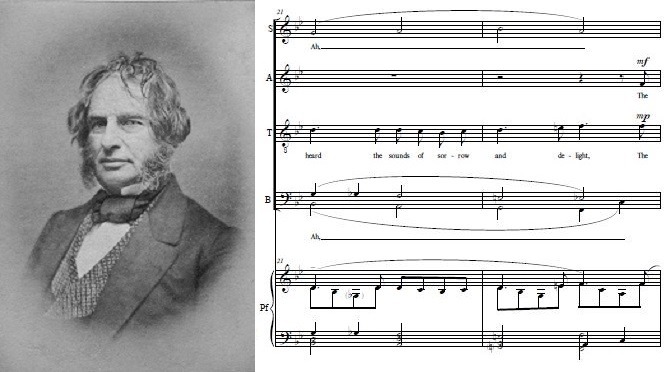
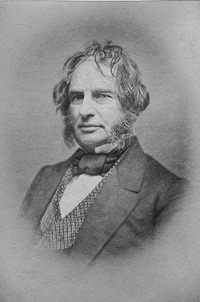
As recounted in an earlier post to this blog, in 1984 I was directing a small amateur mixed chorus in Atlanta, GA. As an active composer, I wanted to compose a work for them to perform, so I searched for a text suitable to my personal Romantic musical style. I eventually turned to the American poet Henry Wadsworth Longfellow (1807-1882), whose poems were not only deeply Romantic but also known for their musicality and melodiousness. I chose his Hymn to the Night, written in the summer of 1839, and Hymn to the Night also became the title of my setting, which is for SATB chorus with piano accompaniment.
For reasons explained in the earlier blog post, the work was not performed for move than four decades. Finally, on September 28, 2025, it received a highly successful premiere performance by the Chancel Choir of the Vineville (GA) United Methodist Church, directed by Cannon McClain, with myself at the piano. Just prior to the concert, we also produced a good recording, which provides the soundtrack for the score video of the composition at the end of this post.
Longfellow’s original poem consisted of six quatrains. I made some minor modifications to it in my musical setting, as indicated below.
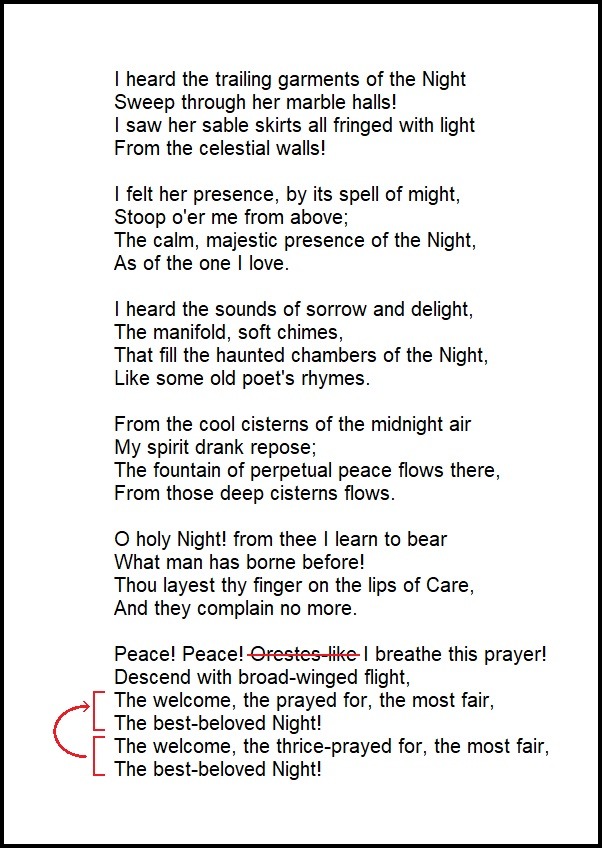
Just before the poem proper, Longfellow added the the epigraph “Aspasie, trillistos,” which comes from Homer’s Iliad and translates from ancient Greek as “Welcome, thrice prayed for.” Note that these words appear in English in the next to the last line of the poem. Of course, the epigraph is not included in the musical setting. But clearly the final two lines contain the core of the poem’s meaning, and they also coincide with the dramatic climax in my musical setting. In the musical setting, I build up to that climax by inserting two additional lines. As can be seen in the pic, the new lines are similar to the final lines but with the word “thrice” omitted.
Earlier in the same quatrain, Longfellow’s original poem also included another classical allusion, this one to the figure Orestes, who according to Greek mythology prayed to the gods for sleep and peace. My musical setting omits the phrase “Orestes-like” in order to simplify the rhythm, and also because the allusion was rather esoteric for my purposes.
The setting is in D-flat major, a key which I have chosen for some of my most deeply Romantic compositions. The work also includes several brief excursions to strikingly remote secondary harmonies. Such remote harmonic connections are of course stylistically Romantic as well, and in this case they also reflect the shifting emotions of Longfellow’s poem. The central D-flat major tonality, however, is first firmly established for the listener as well as the chorus in the opening four bars, which are for the piano alone, ending on a fairly straightforward half cadence. The thematic material in this piano introduction reappears near the end of the piece, as will be seen later.
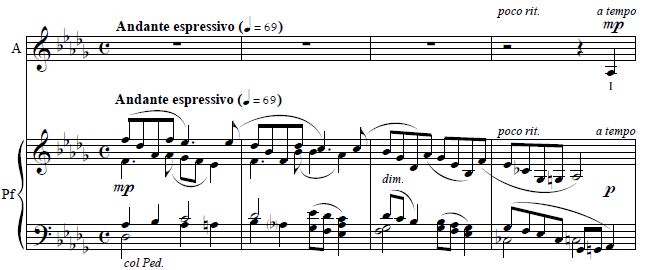
The altos enter at the pick-up to bar 5, with the first two lines (“I heard the trailing garments of the Night / Sweep through her marble halls!”). The sopranos come in with a melodic line imitating the altos four bars later with the next two lines (“I saw her sable skirts all fringed with light / From the celestial walls!”). Four bars after that, the tenors and basses enter with the following lines (“I felt her presence, by its spell of might, / Stoop o’er me from above”). The overall effect of this step-by-step build-up in the musical texture is rather similar to a fugal exposition. The steps also correspond to a sensory progression in Longfellow’s poem, inasmuch as the first pair of lines describes hearing, the second pair describes seeing, and the third pair describes feeling.
Beginning at bar 13 (“I felt her presence, but its spell of might”), the mysterious spell is conveyed by a ♭III (F-flat major) harmony, leading to a cadence on ♭VII (C-flat major) in bars 15-16. The words “Stoop o’er me from above” are directly represented in the shape of the topmost soprano line.
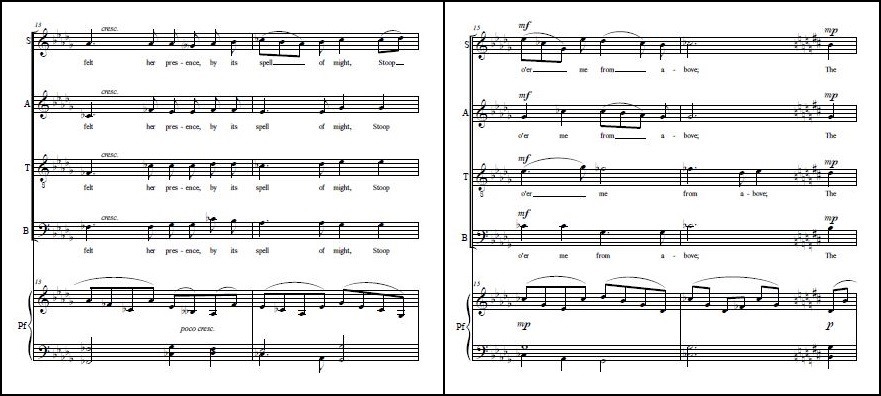
At the end of bar 16, “[t]he calm, majestic presence of the Night” is reflected in a shift to G major harmony (based on the common tone C♭ = B♮), leading to a cadence on the dominant D major. A seventh is then added to the D major harmony, which resolves to the parallel G minor at bar 21, where the third quatrain starts.
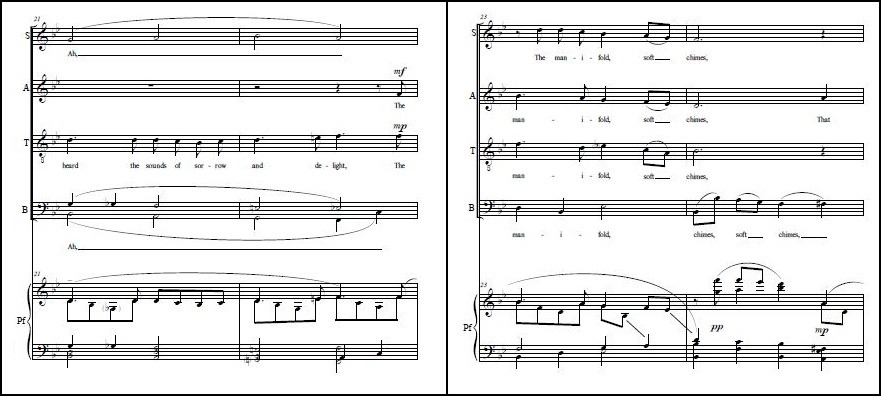
The third quatrain begins with the words: “I heard the sounds of sorrow and delight / The manifold, soft chimes.” The “sorrow” is reflected not only in the change to minor mode (G minor), but also by dissonant harmonies created by passing tones. The “delight” is then accompanied by a movement toward a local B-flat major harmony, and the tintinnabulation of the “chimes” is echoed clearly in the upper register of the piano in bar 24.
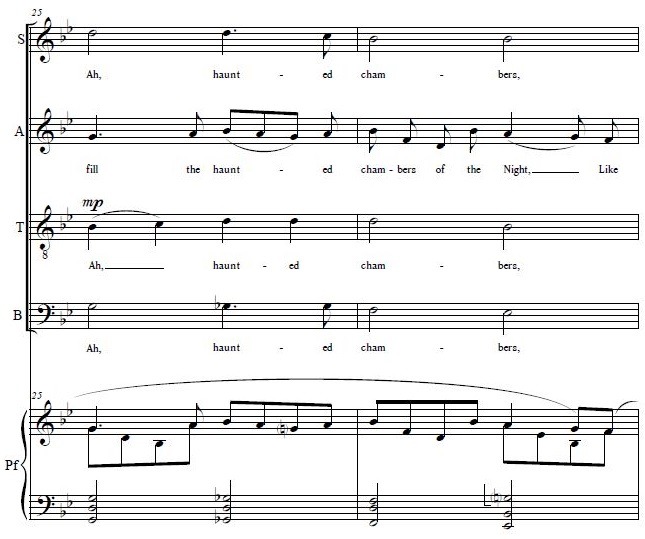
Within the phrase “haunted chambers of the Night,” the word “haunted” is depicted by an eerie passing G♭ augmented triad, against a dissonant G♮ in the alto part.
The fourth quatrain reads: “From the cool cisterns of the midnight air / My spirit drank repose; / The fountain of perpetual peace flows there, / From those deep cisterns flows.” The sense of coolness, repose, and peace is conveyed by a return to the overall tonic key of D-flat major. The flowing from the cisterns is conveyed by a more polyphonic texture, with the tenors dividing into two parts and all five vocal parts pursuing their own independent rhythms.
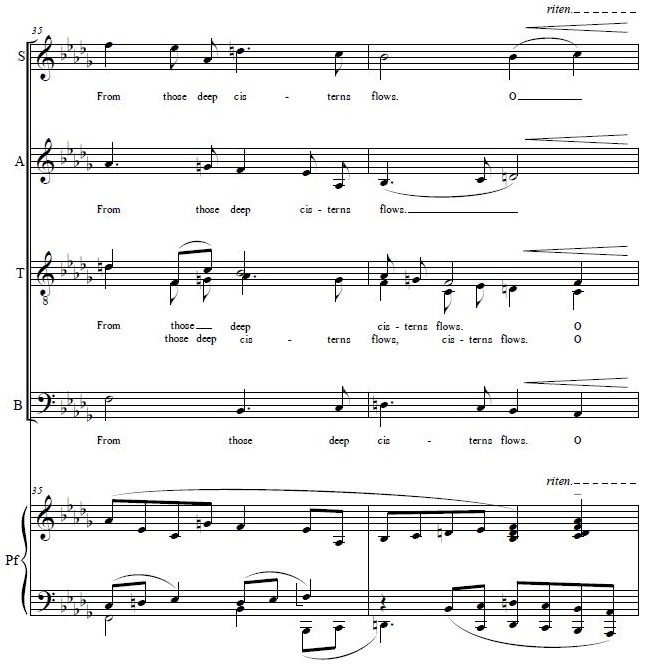
The fifth quatrain begins: “O holy Night! from thee I learn to bear / What man has borne before!” These words seem to suggest a sense of resolve and determination, and the musical texture is correspondingly much more homophonic, especially in contrast with the immediately preceding passage. Even the piano part, which has had flowing eighth notes through most of the composition up to this point, unites in rhythm with the voices here. The rhythm itself is dominated by march-like dotted figures.
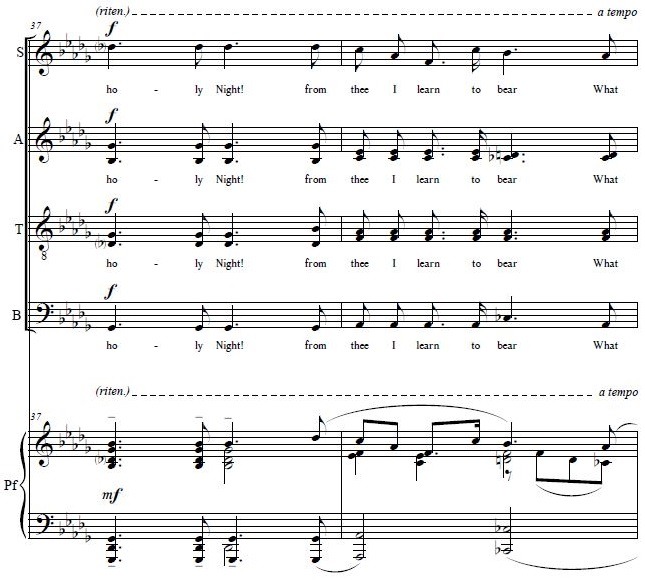
This quatrain ends: “Thou layest thy finger on the lips of Care, / And they complain no more.” Here the words return to the theme of rest and tranquillity, while the music returns to a more polyphonic texture. Longfellow’s words are sung by the altos in this passage, while the tenors and basses vocalize the syllable “Ah.”
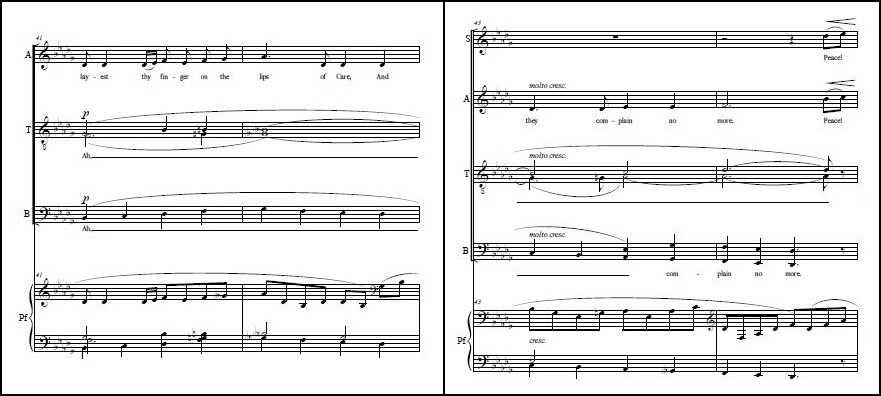
The final stanza begins: “Peace! Peace! I breathe this prayer! / Descend with broad-winged flight.” Here the texture is quite polyphonic and florid. With the second line, all the voices literally descend in pitch, and even the piano part sinks to the bottom of the keyboard. The descending soprano line in these four measures, along with most of the other parts, was previously heard in the piano’s four-measure introduction to the composition.
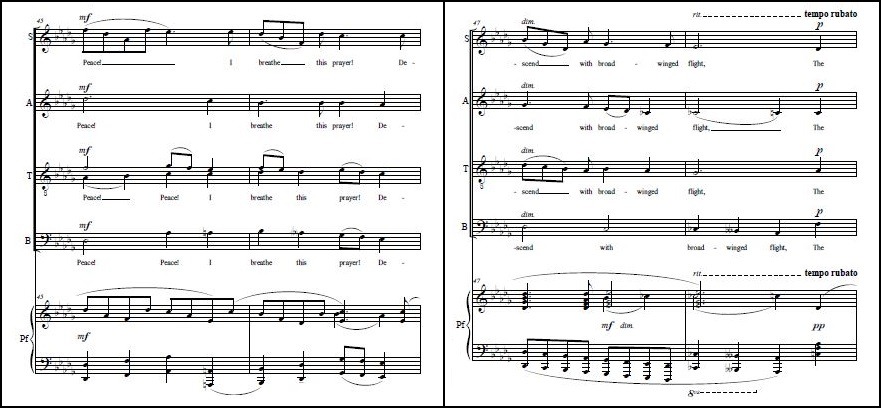
The last two lines of Longfellow’s poem read: “The welcome, the thrice-prayed for, the most fair, / The best-beloved Night!” As explained earlier, these two lines are repeated in the text of this musical setting, except that the word “thrice” is omitted in the first iteration. Musically, the music accompanying the last two lines is a variation of that for the first two, but more embellished, with richer chromatic harmonies, and of course rising to a higher dynamic level to match the dramatic climax of Longfellow’s words. The final measures can be seen below.
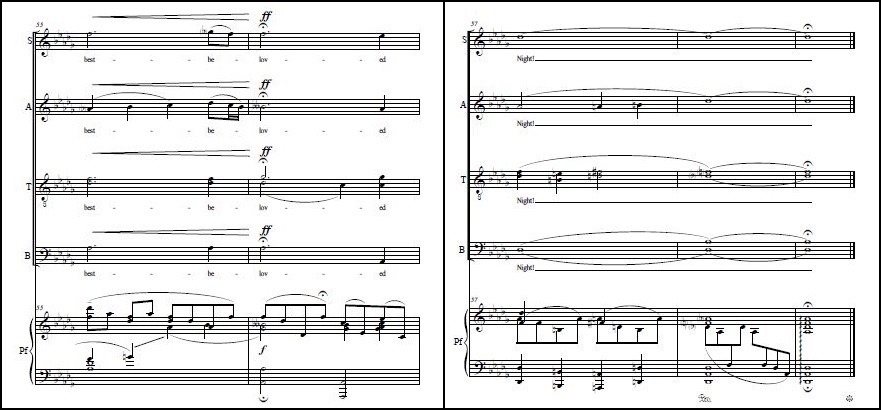
The climactic fortissimo is reached at bar 56. My original 1984 version of this piece was intended for a very small chorus, so in that version I included a decrescendo from the last beat of 56 through the penultimate measure. At the last measure, the chorus dropped out and the work concluded with a pianissimo arpeggio in the piano alone. But when I first rehearsed with the Vineville UMC’s choir in September 2025, I realized that this chorus was much stronger and large enough to allow for staggered breathing. So I decided to modify the ending, removing the decrescendo and letting the chorus hold its parts to the very end. As a consequence, the conclusion of the work became much more powerful and compelling.
Hymn to the Night Score Video:
