The Keyboard Calendar
Our Western tonal system is based on 12 pitch classes, in which seven of the pitch classes are given more “weight” than the other five. The seven weighted pitch classes are determined by the particular major or minor key. In the key of C major, for example, the seven “diatonic” tones that comprise the C major scale — C, D, E, F, G, A , and B — are given more weight than the five “chromatic” tones. The system uses what mathematicians call “modulo 12” arithmetic, because if you start at a certain pitch class and ascend by a semitone 12 consecutive times, you return to the pitch class where you started. On a piano keyboard, the more-weighted diatonic tones in C major are sounded by white keys, while the less-weighted chromatic tones are sounded by black keys.
Our Western calendar is based on 12 months, in which seven of the months are given more “weight” in the sense of length than the other five. Specifically, the seven “long” months — January, March, May, July, August, October, and December — have 31 days each, while the other months are all shorter, ranging from 28 to 30 days. The calendar is again a “module 12” system: If you start at (say) March and increment by 12 consecutive months, you find yourself back at March.
But here’s the truly remarkable part…
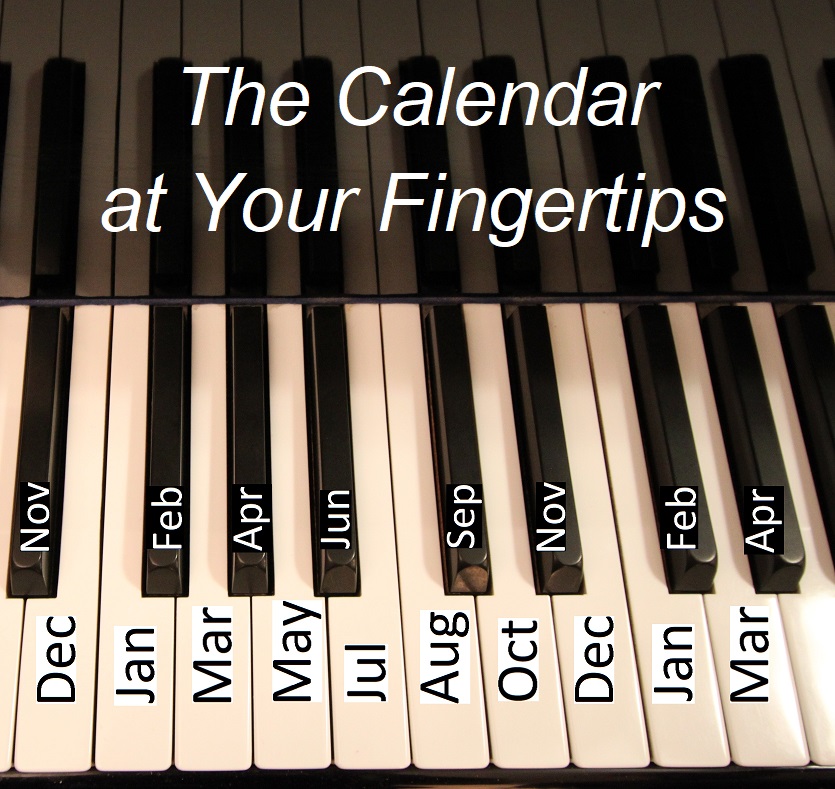
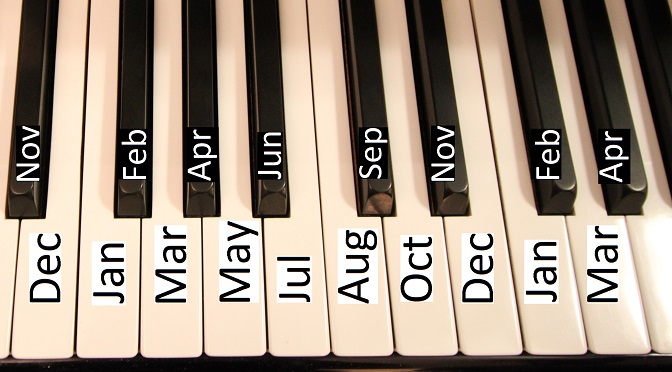
If you align the two systems such than January = F, the longer months (with 31 days) correspond precisely with the physically longer white keys, while the shorter months (with 28 to 30 days) correspond precisely with the shorter black keys.
Traditionally, we think of the calendar as starting at January, so the twelve months of each year correspond to the twelve tones of a chromatic scale starting on F, and each year is an octave higher on the keyboard than its predecessor.
So why bother memorizing “Thirty days hath September…” or learning some awkward knuckle-counting mnemonic? A diagram of the long and short months is right in front of you!
Incredible article, thank you!
This is brilliant! I wrote a suite for solo piano called ‘A Musical Calendar’ back in 1992, without ever realising this…!
Thank you, Richard! I just received your two emails and sent you a reply. I’m glad to meet you!
Hice la misma deducción en 2015.
Sabe Ud. si hay antecedentes sobre ésto?
Lo relaciono con aquellos contemporáneos que sin conocerse arribaron a teorías similares como La evolución de las especies.
De todos modos habría que tener en cuenta ésto: el teclado es un sistema temperado que desdeña las diferencias de semitonos, como por ejemplo la # y si b mientras que la sucesión de meses es un cálculo astronómico de rotación solar sobre la eclíptica.
Saludos.
With regard to your first question, I first thought of the correspondence between the calendar and the keyboard sometime in the last century but did not publish the idea until December 31, 2015 in a Facebook post: https://www.facebook.com/RobertCunninghamsMusic/photos/a.827192074058646.1073741828.818841608227026/828003663977487/?type=3&theater
The sun’s rotation along the ecliptic determines the length of the year, but it is not directly related to the months. (The sun rotates about 366.25 times each year, but since the earth does one revolution around the earth during that same period, we only experience it as about 365.25 days per hear.) The moon goes through between 12 and 13 lunar cycles during a year, and our 12 months are VERY roughly based on that. Beyond that, the specific number of days assigned to different months has more to do with the historical evolution of the modern calendar than with astronomy.
Aclaración: La aritmética de “módulo 12” no es otra cosa que la Ley universal de las Octavas.
Respecto al isomorfismo que trató puede agregarle que se puede corresponder a las teclas y los meses, los signos del zodiaco cuya serie se inicia con Aries el 21 de Marzo y la tecla Sol que es la Clave que da nombre a las demás notas; porque se sabe que Marzo era el comienzo del año en el antiguo calendario romano del que derivó el calendario actual.
Estoy actualmente haciendo un estudio de este tipo de comparación entre series de doce elementos y lo que puede inferirse es realmente sorprendente.
Os saludo.
Thanks for your comment! The isomorphism is curious, interesting, and a lot of fun for musicians. But based on my own understanding of mathematics and probability, I suspect it isn’t really all that mathematically improbable. The two semitones within the diatonic subset (mi-fa and si-do) are situated as far apart as possible from each other within the larger chromatic set. And the inventers of the Julian calendar, which was the predecessor to the modern Gregorian calendar, doubtless tried to place the anomalies of two successive long months (Jul-Aug and Dec-Jan) as far apart as possible from each other within the year.
LA COINCIDENCIA ENTRE LAS NOTAS MUSICALES Y LOS MESES DEL AÑO ES CLARA E INNEGABLE. AHORA BIEN, DE LOS MESES COMO UNA ESCALA O SUCESIÓN FIJA NO PUEDE INFERIRSE MÁS MÚSICA QUE LA DE UNA ESCALA CROMÁTICA ASCENDENTE. EN CAMBIO LA MÚSICA ES UNA SUCESIÓN ARBITRARIA ASCENDENTE Y DESCENDENTE DE SONIDOS SUCESIVOS ( MELODÍA) Y SIMULTÁNEOS (ARMONÍA) QUE PUEDEN SUGERIR ESTADOS ANÍMICOS RESPECTO A LOS MESES (TCHAIKOVSKY: LAS ESTACIONES OP.37) Y A LAS CUATRO ESTACIONES (VIVALDI). ENTONCES, NO HAY VALOR INTRÍNSECO APLICABLE ENTRE AMBAS SERIES POR MÁS QUE SU ISOMORFISMO SEA SORPRENDENTE. NO ES PROBABLE QUE JULIO CÉSAR TUVIERA EN MENTE UNA CORRESPONDENCIA SEMEJANTE CONSIDERANDO QUE LA ESCALA CROMÁTICA Y LOS TECLADOS SON MUY POSTERIORES A ÉL Y COMO RESULTADO DE LA ADICIÓN DE NOTAS INTERMEDIAS A LA ESCALA HEPTAFÓNICA MODAL GRIEGA Y NO COMO UNA CORRESPONDENCIA INTENCIONAL CON LOS MESES DEL CALENDARIO POR ÉL MODIFICADO.
UN AFECTUOSO SALUDO.