
Themes of Sonata No. 2 (Part III)
My last two posts have been describing the use of thematic transformation in my Piano Sonata No. 2 in C Major, a single-movement work in sonata-allegro form. In Part I and Part II, we saw how the three thematic areas of the exposition, although sharply contrasting in character, are all constructed using the same two basic motives. We can see them in the melodic shape of the principal’s theme’s first phrase.
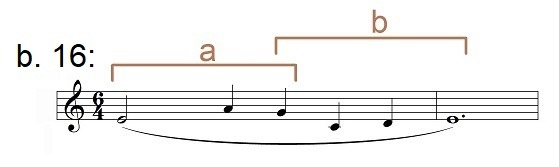
The phrase is composed of an a-motive, consisting of an upward leap followed by a descending step, and a b-motive, which consists of a downward leap followed by two ascending steps. Note that the two motives mirror each other and overlap by one note. This principal theme has a joyful character. It can be heard starting around 1:47 in the video at the bottom of this post.
The development section begins at the Agitato marking the near the end of bar 105 (7:21 in the video). It first introduces a new theme constructed in a very similar manner to the previous themes, except that the two component motives are now both in inversion.
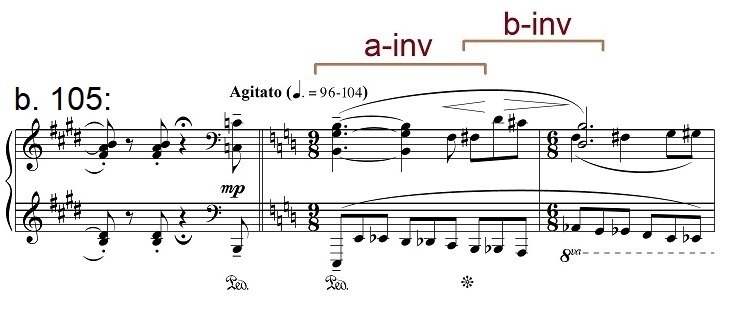
This new theme, which predominates in the first part of the development, can be thought of as a Hegelian antithesis to the principal theme: melodically inverted and transformed from major to minor, from joyful to sinister, and metaphysically from good to evil. In bars 106-134, it has a distinctly diabolical quality. The tempo slows leading into bar 135, and the theme then reappears in longer note values, coming across now as a sorrowful lament. At bar 145, there begins a cadenza-like passage (marked vivace con fuoco), which rises to a climax in bar 157, followed by a long decrescendo and ritardando. The whole passage is suggestive of a cataclysmic struggle, where the inverted motives a-inv and b-inv) still dominate, but with same passing references to the original a-motive as well.
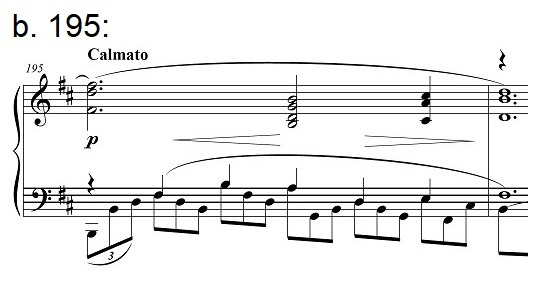
Another new theme is introduced at b. 170 (10:42 in the video), using the a-motive and b-motive from the principal theme (i. e, not inverted), but initially cast in a minor key.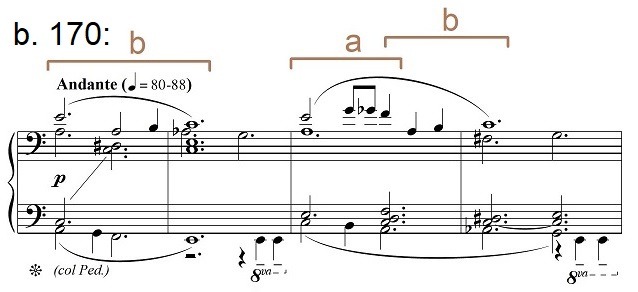
This new theme is subsequently placed in counterpoint against portions of the principal theme (bb. 178-179 and more extensively in bb. 195-201). Here the new theme appears on top, while the opening phrase of the principal theme can be seen in the up-stem notes on the lower staff:
The last section of the development features a long march (bars 218-251, starting around 14:50 in the video). The march theme combines the a-motive and b-motive, overlapping by one note in much the same way as the principal theme, except that here the b-motive crosses the boundaries between successive phrases of the theme.
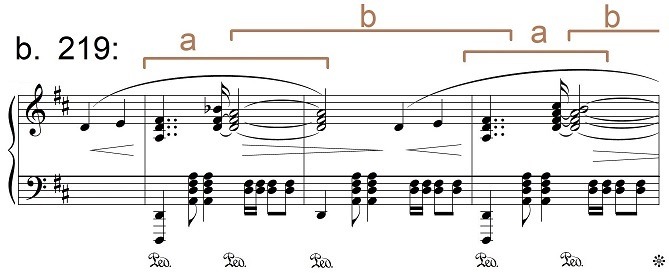
The march begins pianissimo, then builds gradually to a powerful climax at bar 252. A ten-bar transition leads to the recapitulation at bar 262.
The device of thematic transformation also extends into the work’s coda. Particularly notable is a theme that begins at the end of bar 357, marked Largo cantabile.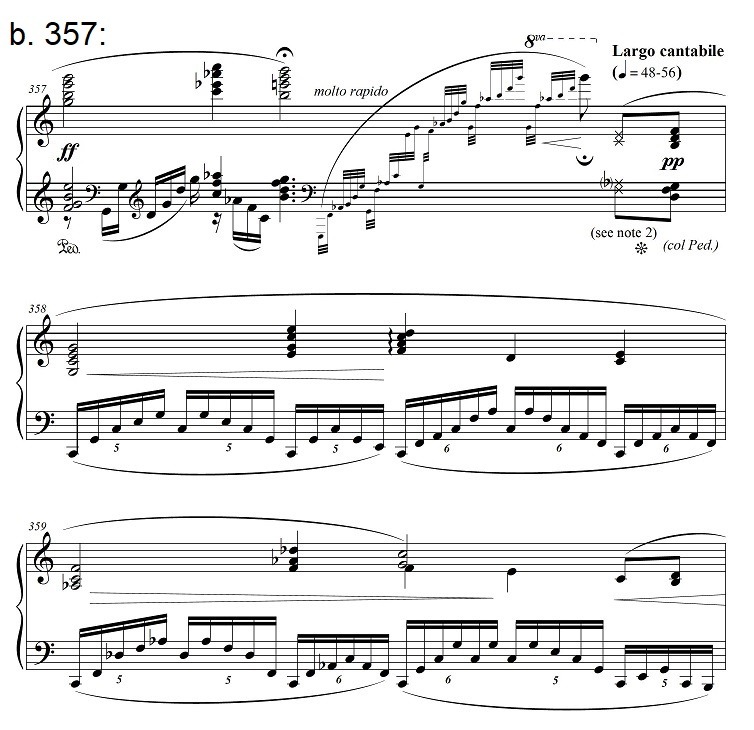
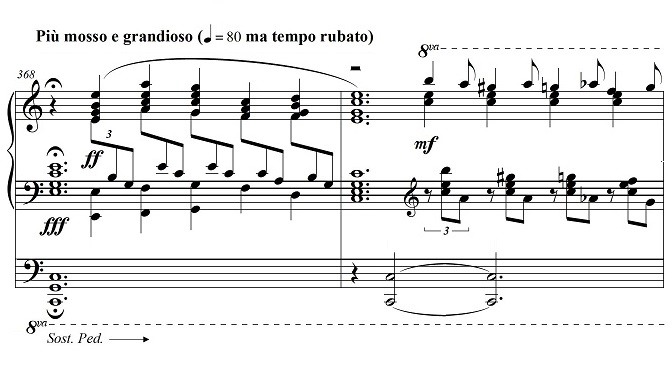
Bar 357 uses an unusual pianistic device (starting around 23:53 in the video): A climactic chord and an arpeggio decorated by nonharmonic tones are captured in the pedal, then four selected keys (notated with special noteheads) are pressed silently, after which the pedal is then gradually released, leaving only the quiet sound of the new theme’s four-note first chord. Emotionally, this coda theme seems to encapsulate the entire sonata. As one might expect, it is based on the same overlapping a– and b-motives as before, but nevertheless seems different in character from all the previous themes, more spiritual and contemplative. It begins very quietly and reflectively, eventually building to a grand triple-forte climax at bar 368 (25:20 in the video).
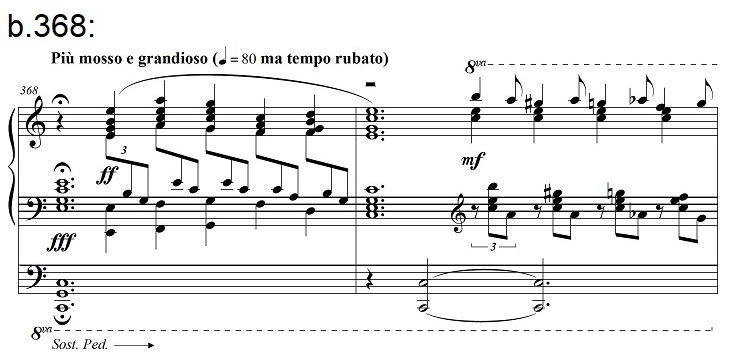
Here one can easily imagine the tolling of bells, which seem to convey a final message of hope and joy.
Piano Sonata No. 2 Score Video:
